"FireAid — watching the charity concert on Netflix, lots of wired microphones and Lewitt capsules. Each artist uses their own microphone model and/or wireless system. But seeing this amount of Shure + Lewitt and wired Lewitt in one concert is something I’ve never seen before." — Nadia Bondarets.
Have you ever experienced waiting for the live performance of your favorite band or artist, and when it finally happens, something feels off? It seems like there’s plenty of energy, there’s drive, but the sound isn’t the same as the recordings. There’s no clarity, no depth, no magic. And you’re not alone — even musicians themselves often feel disappointed when they can’t replicate the studio sound on stage.
One of the reasons for the gap between studio and live sound is the microphones. In the studio, large condenser microphones are usually used, which capture the smallest nuances of the voice or instrument perfectly. However, they are too sensitive for the stage — they can pick up unwanted noise, background hum, and even cause feedback that "kills" the sound with a rumbling and whistling in the speakers.
That’s why dynamic microphones are more commonly used for concerts. One of the most famous is the Shure SM58. It has been used for over 50 years. It’s not as delicate in sound reproduction, but it’s durable and reliable. But the question arises: is there a microphone that combines the best qualities of both types — capturing the fine details of the voice like a studio condenser mic, and being resistant to noise and external sounds on stage like a dynamic mic?
That’s the real challenge for musicians and sound engineers: to find a microphone that can deliver stage sound as well as it does in the studio.

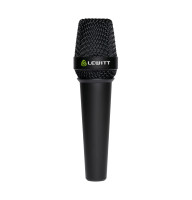
At Lewitt, they are convinced that achieving studio-quality sound in live performances is entirely possible. With this goal in mind, they created the Lewitt MTP W950. This flagship condenser microphone combines the sensitivity of studio equipment with the durability of a dynamic microphone. It can be used in both wired and wireless modes.
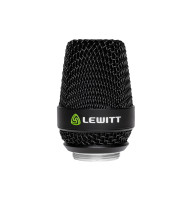
If you need a versatile microphone that works for both stage performances and recording while maintaining clarity and detail in the sound, the Lewitt MTP W950 could be the perfect choice. By the way, even Stevie Wonder chose this model: he uses the W9 capsule (a detachable microphone head that fits the MTP50 handle) in his wireless setup, and also has three wired MTP W950 microphones at different keyboard setups. This is a true endorsement of quality from a world-class musician.
Lewitt was founded in 2009 by Roman Pershon, who set an ambitious goal: to change the perception of what modern microphones should be. His idea was to use the latest technologies to create convenient and high-quality equipment for both beginners and professional musicians.
Today, Lewitt's product range is impressive in its diversity, and the brand has already earned several prestigious awards for innovation. Lewitt confidently presents itself as one of the most dynamic and fastest-growing companies in the microphone market.
The Lewitt headquarters and development center are located in Vienna, Austria, while manufacturing is concentrated in China. The company has chosen an unconventional approach: instead of transporting components from different parts of the world, it sources all necessary parts directly where production takes place. This allows Lewitt to achieve an excellent balance between price and quality of its products.

Lewitt has teams in Europe, China, and the USA, enabling it to create a global network that is both close to users and allows the efficient use of modern, cost-effective production processes. To ensure the highest quality of its products, Lewitt has developed an automated quality control system that allows each microphone to be tested during the production stage. This system ensures precise adjustment of the microphones’ sensitivity, ensuring consistent and reliable sound quality.
The Lewitt MTP W950 model was created in response to the requests of artists and sound engineers who strive for the best sound quality without the typical issues associated with live microphones. It is designed to be convenient for vocalists and to handle all the challenges of live performances. The Lewitt team includes experienced live sound specialists, so the company knows exactly what difficulties musicians face in practice.
Often during rehearsals, there is no opportunity to set up a full wireless system, so vocalists use a wired microphone. However, on stage, a different one — a wireless microphone — is used, and this causes discrepancies in sound, which nullifies all previous preparation.
To solve this problem, Lewitt made the MTP W950 versatile: it can be used in both wired and wireless modes. This way, the artist gets the same sound quality both during rehearsals and on a large stage. The microphone is equipped with a 1-inch true condenser capsule, which provides studio-level sound — much higher than most stage microphones.

The goal of creating the Lewitt MTP W950 was to allow listeners to hear the artist's voice with all the nuances, as clearly and richly as it would be in a recording studio. However, during live performances, artists constantly move around the stage, sometimes approaching drums or guitar amplifiers, which can introduce unwanted sounds into the vocal mix and spoil the overall sound. To avoid such problems, Lewitt developed a system with an exceptional level of rear noise rejection — up to 90%, which is one of the best in the industry.
Another common issue on stage is "cupping" (holding the microphone with hands). When a singer grips the microphone too tightly around the grille, the characteristic directivity (cardioid pattern) changes to omnidirectional, which causes feedback and noise. Lewitt solved this issue too: the MTP W950’s design allows the microphone to be held high, practically at the grille, without distorting the sound. Additionally, the microphone head basket features a natural barrier that prevents the artist from gripping the mic any higher — a behavior often seen in rappers.
Special attention was given by engineers to the durability of the device. The microphone was tested for drops to ensure it wouldn't let you down, even in the hottest moments of a performance. The MTP W950 easily withstands at least six drops from a height of two meters, each time at a different tilt angle (every 45°), as well as two drops — on the front and back of the body. With such features, it could compete not only on stage but also in the ring!

The Lewitt MTP W950 microphone has a relatively high output level compared to many dynamic stage microphones. Thanks to its studio condenser technology, it doesn’t require excessive signal amplification to achieve quality sound — unlike most dynamic models.
This microphone has already gained popularity among professionals. For example, Caleb James, a professional sound engineer and director of Stay Faded LLC, which handles sound for many world-class stars, shares an interesting case.
“At one of the recent Victoria’s Secret shows,” says James, “rapper Lalisa Manobal from Blackpink was supposed to perform with her custom microphone. But when she went on stage, it turned out that the microphone was completely failing — the voice was ‘getting lost’ in the mix due to poor isolation. The venue was like an old abandoned warehouse, with difficult acoustics and strong sound reflections that only worsened the situation. The sound quality turned out to be unacceptable.”
“Luckily, I had the Lewitt W9 with me — we quickly swapped the capsule, set it to a supercardioid pickup pattern, and the result exceeded expectations: Lisa’s voice became clear and well-defined in the mix, even in such challenging acoustic conditions. This microphone literally saved the performance!”

Another well-known artist who works with Caleb James is Stevie Wonder. The legendary musician uses the MTP W9 capsule in his wireless microphone and also has three wired MTP W950s placed on separate keyboard stations. In addition, six more W9 capsules are used for the backup vocalists in his band, mounted on wireless microphones.
“I really like the built-in switches under the Lewitt capsule grills — specifically the 12dB attenuator, the low-cut filter, and the ability to switch between cardioid and supercardioid pickup patterns,” says James. “We set all the microphones on stage to supercardioid mode, activated the low-cut, and the 12dB pad. This allowed us to significantly reduce the level of external noise from the stage, achieving excellent vocal isolation. Even when the full band, choir, and a 12-piece orchestra performed simultaneously, the system worked flawlessly, providing clear and expressive sound.”
“Another example is Lil Yachty’s performance,” continues James. “His vocals are very loud and emotional, so I use the 12dB signal pad to avoid capsule overload. Also, the microphone handles his grip style very well — he often ‘cups’ the microphone, but even in such conditions, the frequency response isn’t distorted like it is with most other microphones.”

Conclusion: The Lewitt MTP W950 is a true all-round microphone. The combination of Austrian engineering, thoughtful design, efficient production, and a team truly passionate about music gives every reason to believe that the MTP W950 has a great future ahead. This microphone could very well become as popular as the legendary Shure SM58, but with the advantage of offering much more detail and finesse, typical of classic condenser microphones.
Source: forbes.com: Lewitt MTP W950 Is The Ultimate All-Round Microphone For Stage And Studio


Write a comment