How do microphones work?

Today we are going to talk about 2x types of microphones for recording: dynamic and condenser. And also you will find out why they are not that good listeners.
Prefer to watch videos rather than read texts? See below!
So how does the microphone work?
Each microphone works in the same way. Sound waves hit the membrane and make it move in accordance with the source.
- The energy of the sound wave must be converted into an electrical signal or voltage. And there are different ways to do it.
1)So when you start to speak, you start to make a sound.
2)The sound waves then hit the microphone membrane.
3)The microphone converts this movement into an electrical signal that can now be used for a variety of purposes, such as:
- Recording
- Communication
- Gain
Microphone types
In this article, we'll focus on dynamic and condenser microphones for recording. There are other types of microphones, of course, but they are not commonly used for recording. Roughly speaking, dynamic microphones are used in noisy environments. Condenser microphones are used for accurate recordings. And soon you will find out why this is so!
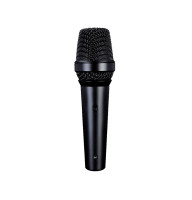
Listen to the sound samples below and feel the difference. Dynamic microphones are mostly forward facing, which means we need to point the microphone towards the sound source like this:
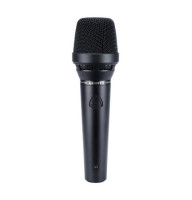
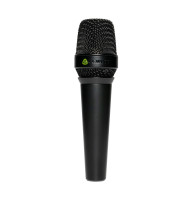
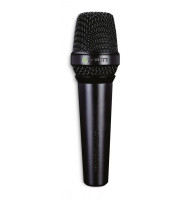
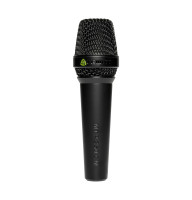
Here's a typical dynamic handheld microphone that's often used by singers on stage.
Female Vocals - MTP 550 DM 0:10
How does a dynamic microphone work?
The capsule and its membrane are located under the mesh.
Do you see the foil in the picture? This is the membrane.
- The dynamic microphone has a fairly sturdy capsule and is therefore typically used for live performances.


1)The back of the diaphragm is attached to a wire spool.
2)Both the diaphragm and the coil move back and forth in accordance with the incoming sound waves.
3)The coil is placed in a magnetic field, and as it moves, an electrical signal is induced.
When you think about it, it might remind you of how a loudspeaker works. This is because they both work on the same acoustic principle, and a dynamic microphone can be said to be an inverted speaker.
Dynamic microphones are extremely durable and ideal for
- Live vocals
- Guitar Cabinet
- Snare drum and barrels
How does a condenser microphone work?
Condenser microphones are mainly used to create detailed studio recordings. There are 2 types of condenser microphones: small diaphragm microphones and large diaphragm microphones.
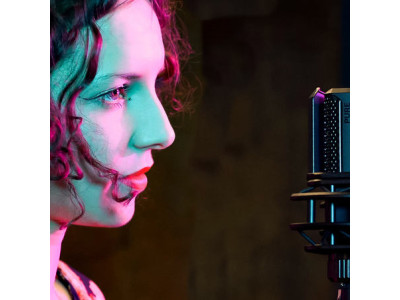
This is the typical large diaphragm microphone you will often see in the studio when recording vocals.

The next microphone is a small diaphragm condenser microphone. It is also called a pencil microphone because of its shape. It is ideal for recording acoustic instruments.

Let's take a look at how a condenser microphone works. It doesn't matter if it's a condenser microphone with a large diaphragm or a small diaphragm - both work the same way. Here is the large diaphragm condenser microphone. We removed the grid to see what's inside.
- The membrane is very thin and light, so it reacts very accurately to sound. This is why condenser microphones sound so clear.
- The membrane is electrically charged and has a back plate attached to it.
- Together, the diaphragm and back plate form a capacitor.
- When sound hits the diaphragm, the capacitance changes, and with the help of internal electronics, condenser microphones can convert this capacitance change into an electrical signal.
- All condenser microphones require power to operate the internal electronics. For professional microphones, this is called phantom power. It is 48 volts and comes from an audio interface or mixing console.
These microphones are best suited for...
Small diaphragm condenser microphones are ideal for acoustic instruments such as guitars or strings.
Large diaphragm condenser microphones are indispensable for recording studio vocals.
Why microphones are bad listeners - cocktail party effect.
And now the shocking truth! Microphones can't hear! Yes, you read that correctly.
- Listening is more than just receiving sound waves. This is selective attention in the auditory system.
This is what is called the cocktail party effect.
Imagine that you are at a party and talking. There is an atmosphere ... some music in the background, other people talking, ambient noises. When all of this happens at the same time, why can you still focus on the conversation you are having?
Well, this is possible because your brain is able to “turn off” sounds that it does not want to focus on, that is, you hear selectively. The microphone cannot do this, it has no way of taking his attention
This is why you should always pay attention to the noises around you before pressing the record button or broadcasting your channel.
Become a microphone
Train your ears to work like a microphone and pick up whatever you can. Become a microphone and you will immediately improve the quality of your recordings.
Check for noise that you usually ignore:
- Noise outside
- Others around you
- Air conditioner
- Your computer
Just remember, it's not about perfect gear or surroundings, it's about making the most of what you have.



Write a comment