
 0
0
 0
0
 0
0
 0
0
 0
0
0
0
0
0
 0
0
 0
0
 0
0
0
0
 0
0
 0
0
 0
0
 0
0
 0
0
0
0
 0
0
 0
0
 0
0
0
0
 0
0
 0
0
 0
0

 Shure Incorporated is an American audio products corporation. It was founded by Sidney N. Shure in Chicago, Illinois in 1925 as a supplier of radio parts kits. The company became a consumer and professional audio-electronics manufacturer of microphones, wireless microphone systems, phonograph cartridges, discussion systems, mixers, and digital signal processing. The company also manufacturers listening products, including headphones, high-end earphones, and personal monitor systems. Shure was founded by Sidney N. Shure in 1925 as "The Shure Radio Company", selling radio parts kits several years after completely manufactured radios became commercially available. The company's office was located at 19 South Wells Street in downtown Chicago, Illinois. The following year, Shure published its first direct mail catalog, which was one of only six radio parts catalogs in the United States at the time. By 1928, the company had grown to over 75 employees, and Sidney's brother, Samuel J. Shure, joined the company, which was renamed Shure Brothers Company. The company moved into new offices at 335 West Madison Street in Chicago. In 1929, with the advent of the Great Depression and the increased availability of factory-built radios, Shure Brothers Company was forced to greatly reduce their staff and became the exclusive US distributor of a small microphone manufacturer. In 1930, Samuel J. Shure left the company.
 In 1931, Shure and engineer Ralph Glover began development of the first Shure microphone, and the following year, the Model 33N Two-Button Carbon Microphone was introduced, making Shure one of only four microphone manufacturers in the U.S. Shure's first condenser microphone, crystal microphone, and microphone suspension support system (for which they received their first patent) were all introduced that same decade. In 1939, Shure introduced the Model 55 Unidyne Microphone, which went on to become one of the world's most recognized microphones. In 1941, Shure was contracted by the United States armed forces to supply microphones during World War II, and by the following year, the T-17B was the microphone most widely used by the U.S. Army and Navy. Shure also manufactured throat, headset, and oxygen mask microphones, and adopted the United States Military Standard for all Shure microphones. By the mid-1940s, Shure was also manufacturing and supplying phonograph cartridges to major phonograph manufacturers including Philco, RCA, Emerson, Magnavox, Admiral, and Motorola, and was the largest producer of phonograph cartridges in the U.S. at that time. Among Shure's innovations in phonograph cartridge design was Ralph Glover and Ben Bauer's "needle-tilt" principle for minimizing record wear while improving sound reproduction, and Jim Kogen's engineering concept of "trackability." Shure produced the first phonograph cartridge capable of playing both long-playing and 78 rpm records, the first cartridge with tracking force of only one gram, and the first cartridge meeting the requirements of stereo recording. At the peak of Shure's phonograph cartridge production, the company was producing approximately 28,000 cartridges per day, with 25,000 of those coming from a Shure phonograph cartridge plant in Phoenix, Arizona. After the introduction of compact discs in the 1980s reduced the demand for phonograph cartridges, Shure closed the Phoenix facility but continued manufacturing phonograph cartridges, and continues to manufacture them today.
Shure also developed and produced products for medical applications. In 1937, their 66A piezoelectric stethophone was designed to accurately reproduce chest sounds, and in the early 1960s, the SP-5, SP-5S and SP-6 stethoscope pickups were produced. Shure also produced hearing aid cartridges used in hearing aid products from manufacturers like Maico, Telex, Dictograph, Otarian, Vocalite, and Trimm.
In 1956, Shure moved its corporate headquarters to Hartrey Avenue in Evanston, Illinois, where it remained for 47 years. Beginning in 1956, Shure manufactured magnetic tape recording heads and two years later, the company announced it was ready to mass-produce 4-ch recording heads. By 1964, however, Shure announced it would no longer produce tape recording heads due to increased competition.
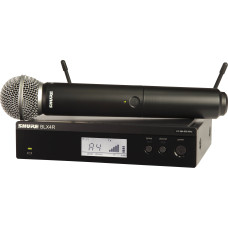
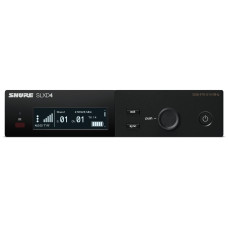
In 1953, Shure introduced their first wireless microphone system for performers, and in 1959, they introduced the Unidyne III Microphone, which was the predecessor to the SM57, which would be introduced, along with the SM58, six years later. Shure also produced portable equipment for broadcast field recording like Vocal Master, the M67 Portable Mixer, and the FP31 Portable Mixer. In 1990, Shure entered the wireless microphone market with the L-Series.
In 1981, James Kogen, Executive Vice President, Operations, was promoted to President and General Manager of Shure. In 1995, Sidney N. Shure died at the age of 93, and Rose L. Shure was elected Chairman of the Board of Directors. In 1996, James Kogen retired; Santo (Sandy) LaMantia, Vice President of Engineering, was named President and CEO. Shure Brothers Incorporated was officially renamed Shure Incorporated in 1999.
In 2001, Shure acquired the Popper Stopper brand of studio pop filters from Middle Atlantic Products Inc. The following year, Shure adopted hearing conservation as the company’s corporate cause and established the Shure Bid for Hearing program. In 2003, Shure moved into new corporate headquarters in Niles, Illinois, into a building designed by architect Helmut Jahn that was originally the headquarters of HALO Industries. The 65,000-square-foot (6,000 m2) Technology Annex designed by Krueck and Sexton Architects, opened in 2005, houses Shure's Performance Listening Center. In 2008, Shure celebrated the opening of The S.N. Shure Theater and Interactive Display at their corporate headquarters.